
Question
Gramps,
A question about baptismal fonts in the temples came up in our Family Home Evening group. Are all the fonts in the new smaller temples built below ground level like in the older temples? Explain the significance of them being built in the basement below ground level. Thank you.
Marian
Answer
Dear Marian,
When visiting a temple of The Church of Jesus Christ of Latter-day Saints, one architectural feature stands out both for its beauty and its deep symbolism: the baptismal font. Often found beneath the temple’s main floors, the font serves as a vessel for performing sacred ordinances for both the living and the dead. But why is the font typically placed below ground level, and what significance does this design hold in the theology and practice of the Church?
The practice of building baptismal fonts below ground can be traced to the early days of The Church of Jesus Christ of Latter-day Saints, particularly during the construction of the Nauvoo Temple in the 1840s. After the Saints were commanded by revelation to build a temple, part of the instruction received by Joseph Smith concerned baptisms for the dead—a new and revelatory ordinance at the time. The Lord revealed that a baptismal font was to be constructed for this purpose. While early proxy baptisms were permitted in other locations such as the Mississippi River during a period of poverty and lack of a dedicated temple, the Lord directed, “for a baptismal font there is not upon the earth, that they, my Saints, may be baptized for those who are dead; for this ordinance belongeth to my house, and cannot be acceptable to me, only in the days of your poverty, wherein ye are not able to build a house unto me.” (Doctrine & Covenants 124:29-30)
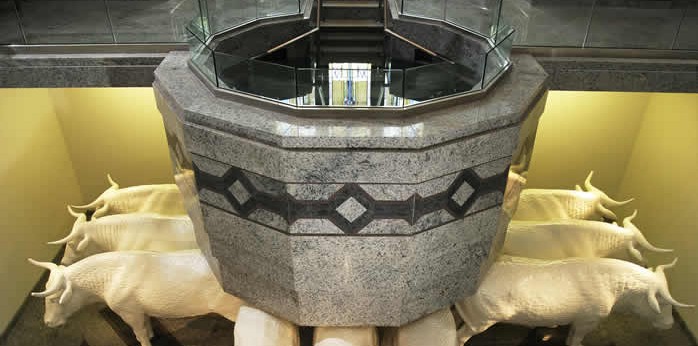
By the fall of 1841, as construction of the Nauvoo Temple basement progressed, carpenters completed a temporary font made of pine, assembled from tongue-and-groove staves. Located near the east end of the basement, this font was seven feet high and measured twelve by sixteen feet. Decorated with ornate moldings and supported by twelve carved oxen—a pattern still followed today—it became the standard and symbolic model for temple fonts. The water for the font was supplied from a thirty-foot-deep well at the east end of the basement, emphasizing both the practical and spiritual foundation-laying that undergirded temple work.
Joseph Smith declared on October 3, 1841, that henceforth all proxy baptisms for the dead must take place within the temple, in the sacred, subterranean setting of the font.
The location and construction of baptismal fonts in the basement or below ground are not merely practical decisions but are revealed doctrine and sacred symbolism. Doctrine and Covenants 128:13 provides the clearest explanation: “Consequently, the baptismal font was instituted as a similitude of the grave, and was commanded to be in a place underneath where the living are wont to assemble, to show forth the living and the dead, and that all things may have their likeness, and that they may accord one with another—that which is earthly conforming to that which is heavenly.”
This instruction ties the physical act of baptism to the spiritual metaphors prevalent throughout Christian scripture: the descent into the water as a symbol of burial and the emergence from the water as a figure of resurrection. Baptism, in this context, is an earthly drama that mirrors the eternal realities of death and rebirth. Placing the font below ground, in an area “underneath where the living are wont to assemble,” reinforces this powerful symbolism. The candidate for baptism symbolically descends into the grave (the water) and is raised to newness of life, just as believers anticipate the resurrection.
The design also harmonizes with Paul’s teaching in 1 Corinthians 15, where the Apostle contrasts the natural (earthly) with the spiritual (heavenly), and explicitly refers to baptisms performed on behalf of the dead: “Else what shall they do which are baptized for the dead, if the dead rise not at all? why are they then baptized for the dead?” (1 Corinthians 15:29). These scriptural allusions reveal the temple font as both a place of hope for the living and a passageway connecting them vicariously with their ancestors who have passed on.
Over time, the architectural details and placement of baptismal fonts have developed into distinctive traditions within temples of The Church of Jesus Christ of Latter-day Saints. The Nauvoo font, standing on twelve oxen—representing the twelve tribes of Israel—became the template for subsequent temples. Each of these elements is symbolic: the oxen, often stylized and arranged with heads and front legs projecting outward, evoke the ancient brazen sea in Solomon’s Temple, which also stood upon twelve oxen (see 1 Kings 7:23-25). This motif links Latter-day Saint temple ordinances to ancient Israelite worship, emphasizing continuity and fulfillment.
The underground placement of fonts required thoughtful engineering and design. In Nauvoo, the font was located in the temple’s basement, directly under the main hall. The area was enclosed by a temporary clapboard structure until the upper stories of the temple could be finished. Fonts in other historic temples followed suit: they were built in lower levels or basements, physically anchoring the ordinance to the earth in symbol and in stone.
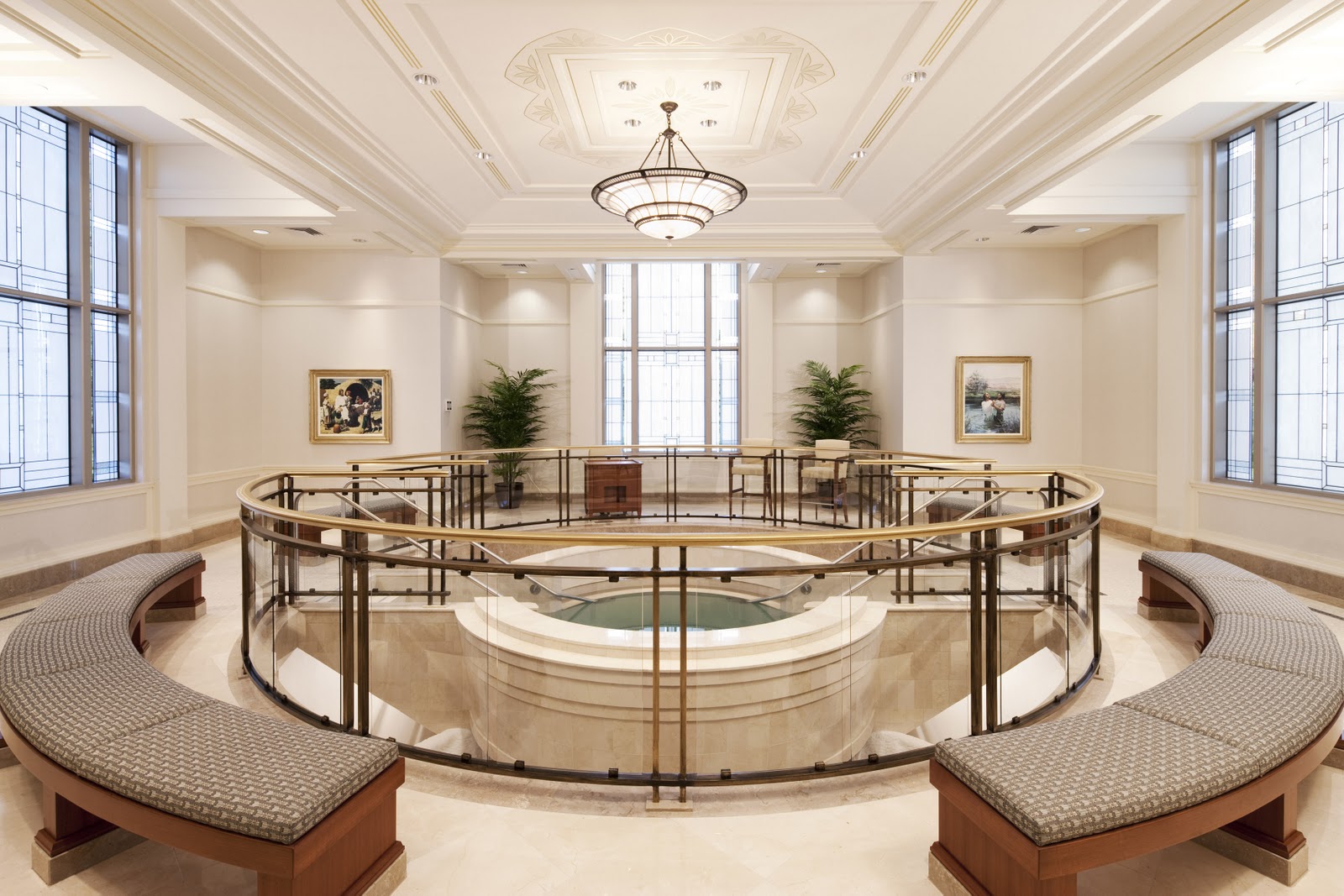
Yet, as temples have been constructed around the globe—with a great diversity of local circumstances and building constraints—the requirement for the font to be strictly “underground” has sometimes been adapted for practical reasons. For instance, certain modern temples feature fonts at ground level due to high water tables or construction limitations, but the symbolism remains integral, either through partial submersion or other methods of placement. The central doctrinal principle remains: the font should represent the grave and serve as a locus where “the living and the dead” are linked.
The legacy of the Nauvoo font, its location, and design continues in the temples built by The Church of Jesus Christ of Latter-day Saints today. Modern fonts still rest upon twelve oxen and are generally situated in a space beneath the main assembly halls. However, temple architects have exercised flexibility in order to comply with geological conditions and construction codes in various parts of the world. For example, in the Buenos Aires Argentina Temple, the font was placed on the ground floor rather than below ground.
Regardless of the specific spatial arrangement, the instructions given through revelation—echoed by generations of Church leaders—affirm the symbolic meaning over particular architectural constraints. The connection between the living and the dead, expressed through vicarious ordinances performed in these fonts, remains a vital force in the doctrine and temple worship of the Church. As Latter-day Saints continue to build and dedicate temples in diverse environments, the adaptation of font placement reminds members that the essence of the ordinance—the uniting of the earthly and the heavenly, the mortal and the immortal—is always paramount.
Gramps